
In global industries, pricing intelligence drives profitability. Retail leverages dynamic pricing engines. Financial markets operate on predictive analytics. Logistics networks optimize using real-time data modeling.
Agriculture — despite being one of the largest economic sectors in India — still largely operates on reactive pricing decisions.
Farmers frequently make selling decisions based on:
- Same-day mandi price
- Trader input
- Peer information
- Urgent liquidity needs
What remains missing is structured, predictive, comparative price intelligence.
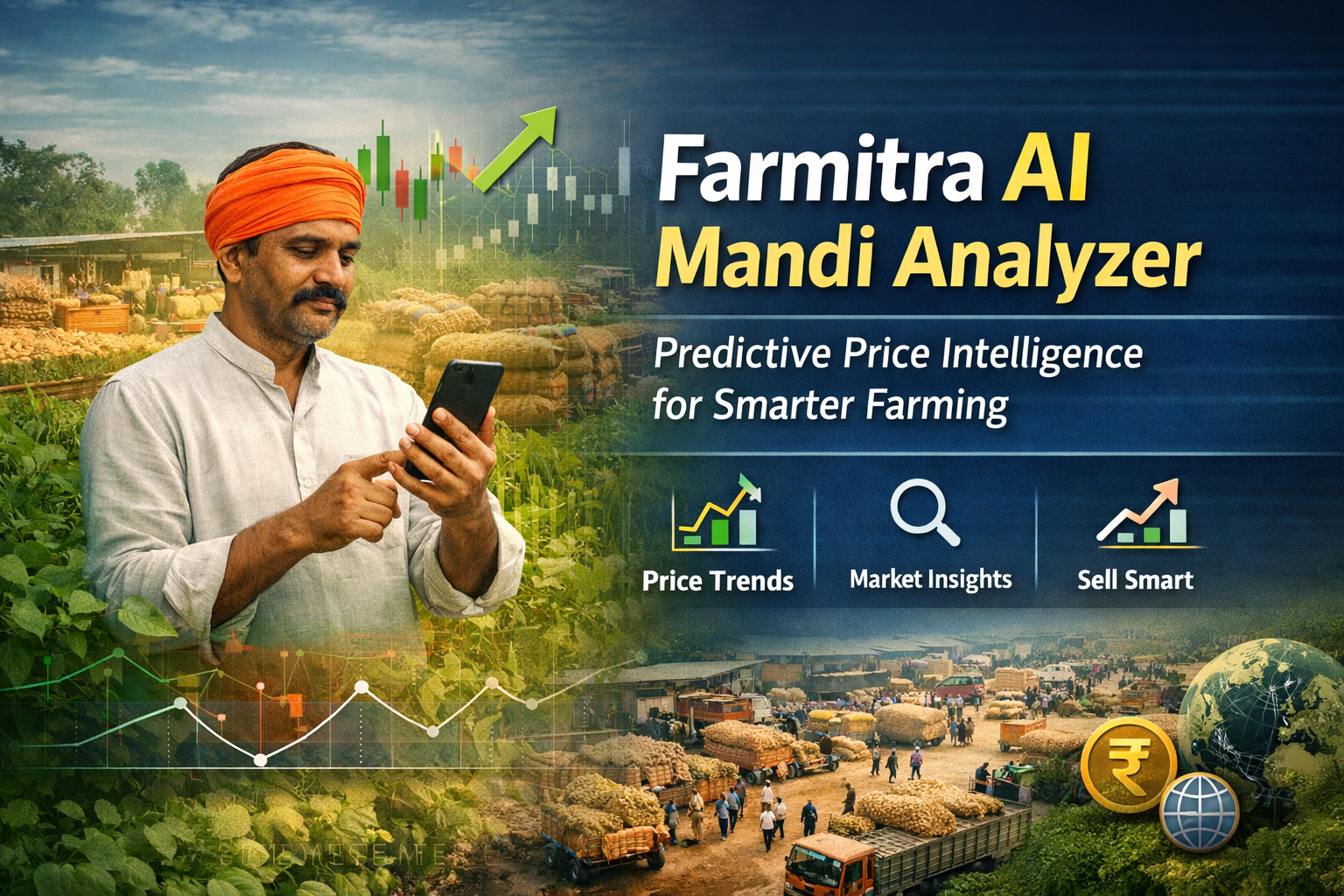
Farmitra AI Mandi Analyzer is designed to solve this structural gap. It transforms mandi data from passive reporting into active decision support.
The Structural Problem in Mandi Price Discovery
India’s mandi ecosystem is decentralized. While this creates local access, it also produces information asymmetry.
Current System Limitations
Most mandi portals provide:
- Minimum price
- Maximum price
- Modal price
- Arrival volume (sometimes)
However, they do not answer:
- Is today’s dip part of a short-term correction?
- Is price movement seasonal?
- Is arrival pressure likely to ease?
- Is another mandi offering better net realization?
- Should the farmer sell today or wait?
Without interpretation, data remains noise.
The Economic Cost of Reactive Selling
Industry observations suggest:
- Inter-mandi price spreads can vary between 5–20% for identical commodities.
- Sudden arrival spikes can reduce vegetable prices by 15–30% within 48 hours.
- Short-term holding of storable crops can increase net realization by 5–12% during demand cycles.
For small and marginal farmers, even a 5% improvement in price realization can significantly impact seasonal income stability.
The absence of predictive visibility increases distress selling.
Farmitra AI Mandi Analyzer introduces predictive clarity.
What Is Farmitra AI Mandi Analyzer?
Farmitra AI Mandi Analyzer is an AI-powered agricultural price intelligence platform that:
- Aggregates multi-mandi price data
- Analyzes historical patterns
- Detects volatility signals
- Maps demand-supply shifts
- Generates probability-based directional indicators
- Provides contextual advisory guidance
It does not promise exact price forecasting.
It provides structured probability-backed decision signals.
How the Intelligence Engine Works
The system operates through layered analytics:
1. Data Ingestion Layer
Mandi rates, arrival quantities, and regional classifications are aggregated across multiple markets.
2. Data Normalization
Outliers are filtered. Duplicate entries are removed. Modal prices are stabilized.
3. Trend Modeling
Short-term and mid-term price movement is analyzed using:
- Moving averages
- Volatility indexing
- Arrival-price correlation mapping
- Seasonal pattern modeling
4. AI Interpretation Layer
Instead of raw charts, the system explains insights in practical language:
- Price rising due to reduced arrival
- Short-term correction likely
- Demand cluster emerging in nearby district
- High volatility detected
5. Advisory Output
Farmers receive signals such as:
- High probability of price stabilization in 3 days
- Immediate sale recommended due to supply surge
- Consider alternate mandi within transport radius
Why Predictive Intelligence Matters in Agriculture
Agriculture is influenced by:
- Weather fluctuations
- Arrival clustering
- Festival demand cycles
- Policy interventions
- Storage behavior
These factors create cyclical volatility.
Without predictive modeling, farmers respond to visible price drops — often at the worst possible time.
Farmitra AI changes the decision dynamic from reaction to anticipation.
Strategic Advantages of Farmitra AI Mandi Analyzer
1. Improved Price Realization
Even modest gains can compound across acreage.
Potential impact:
- 5–10% higher average seasonal selling price
- Reduced distress liquidation
- Smarter dispatch timing
2. Geographic Arbitrage Visibility
Farmers gain transparency across nearby mandis.
Benefits:
- Identify price spreads
- Optimize transport decisions
- Reduce dependency on single local market
3. Supply Pressure Monitoring
Arrival spikes strongly correlate with short-term price dips.
The system detects:
- Sudden volume surges
- Temporary oversupply
- Demand-supply imbalance signals
This enables informed holding decisions (where storage allows).
4. Risk Reduction for Perishable Crops
Vegetables and fruits exhibit extreme volatility.
AI-driven indicators help:
- Avoid selling during peak glut
- Capture short demand spikes
- Minimize spoilage-driven distress sales
Predictive Modeling: What the Data Suggests
Based on agricultural pricing behavior patterns:
- High arrival volumes increase probability of short-term price suppression.
- Arrival decline combined with stable demand increases rebound probability.
- Seasonal demand cycles (festivals, weddings, weather shifts) influence short spikes.
Farmitra AI leverages pattern detection rather than speculative forecasting.
Prediction framework focuses on:
- Directional probability (upward, downward, stabilizing)
- Volatility index (low, moderate, high)
- Holding feasibility window
Economic Modeling: Income Impact Projection
Consider a vegetable farmer selling 100 quintals of produce.
- If average mandi price:
₹1,500 per quintal - 5% improvement:
₹75 additional per quintal
₹7,500 incremental income
Across multiple harvest cycles, this becomes meaningful income stabilization.
For FPO-level aggregation, the impact multiplies significantly.
Pros of Farmitra AI Mandi Analyzer
Commercial Pros
- Data-backed selling decisions
- Reduced information asymmetry
- Enhanced negotiation leverage
- Market timing optimization
Strategic Pros
- Scalable architecture across regions
- Supports integration with agri-fintech
- Foundation for storage financing intelligence
- Enables crop planning alignment
Ecosystem Pros
- Improves supply chain predictability
- Strengthens FPO decision-making
- Supports warehouse timing strategies
- Creates structured agri-market transparency
Addressing Key Concerns
Forecast Accuracy
The system avoids exact price claims. It provides probability-based directional insights.
Data Reliability
Normalization and anomaly filtering reduce misleading signals.
Accessibility
Designed for farmer-friendly interpretation, not technical dashboards.
Scalability
Modular framework supports expansion across crops and states.
Real-World Use Case Illustration
A tomato farmer observes declining price in local mandi.
AI Analysis shows:
- High arrival pressure in current mandi
- Lower arrival trend in neighboring mandi
- Historical pattern suggests 48-hour correction
Decision:
Delay sale or shift to alternate mandi.
Result:
Improved price realization.
The difference is not guesswork — it is probability modeling.
Long-Term Strategic Implications
Farmitra AI Mandi Analyzer represents more than a pricing tool.
It becomes a foundational intelligence layer for:
- Credit risk modeling
- Storage optimization
- Crop diversification advisory
- Commodity aggregation planning
- Policy-level price stability studies
Over time, agricultural ecosystems shift from reactive to predictive.
Future Roadmap
Farmitra AI is evolving toward:
- Personalized crop alerts
- SMS advisory for low-connectivity regions
- Seasonal risk heatmaps
- AI-driven sowing optimization
- Integration with Farmitra Crop Advisory
The long-term vision is agricultural decision intelligence — not just mandi analytics.
Conclusion: Intelligence Is the Next Agricultural Input
Seeds improved yield.
Fertilizers improved productivity.
Mechanization improved efficiency.
The next input is intelligence.
Farmitra AI Mandi Analyzer equips farmers with structured, data-driven market awareness. It reduces uncertainty, enhances price strategy, and strengthens income stability.
In a sector where volatility is inevitable, intelligence becomes the stabilizer.
Farmitra AI Mandi Analyzer is designed to deliver that stabilizer at scale.
The importance of such intelligence becomes evident when we examine the nature of agricultural volatility. Perishable commodities such as tomatoes and onions experience rapid price corrections driven by arrival surges. Pulses and oilseeds follow slower cyclical movements influenced by storage behavior and policy shifts. Fruits respond to seasonal and festival demand clusters. A uniform interpretation model cannot serve all crop categories.
Farmitra AI’s analytical engine recognizes these behavioral differences. It does not attempt to predict exact prices — an inherently unstable exercise in open markets. Instead, it focuses on probability-weighted directional indicators. By identifying whether a current price movement aligns with historical patterns or deviates due to sudden arrival spikes, the system offers contextual clarity without overpromising precision.
The strategic value of this clarity is significant. A marginal improvement of even five to ten percent in price realization meaningfully alters net income for small and marginal farmers. The difference between selling during peak arrival pressure and waiting for temporary stabilization can determine seasonal profitability.
Equally important is the inter-mandi comparison layer. Agricultural markets in India are geographically uneven. Price spreads across adjacent districts often reflect localized supply concentration rather than true demand imbalance. Without comparative visibility, farmers remain locked into their nearest mandi’s pricing dynamics. With cross-market analysis, geographic arbitrage becomes possible — especially for semi-perishable or storable commodities.
Read Articles : Reengineering Post-Harvest Procurement: How Farmitra AI Enables Market-Led Farmer Income Growth
Download Farmitra APP
