
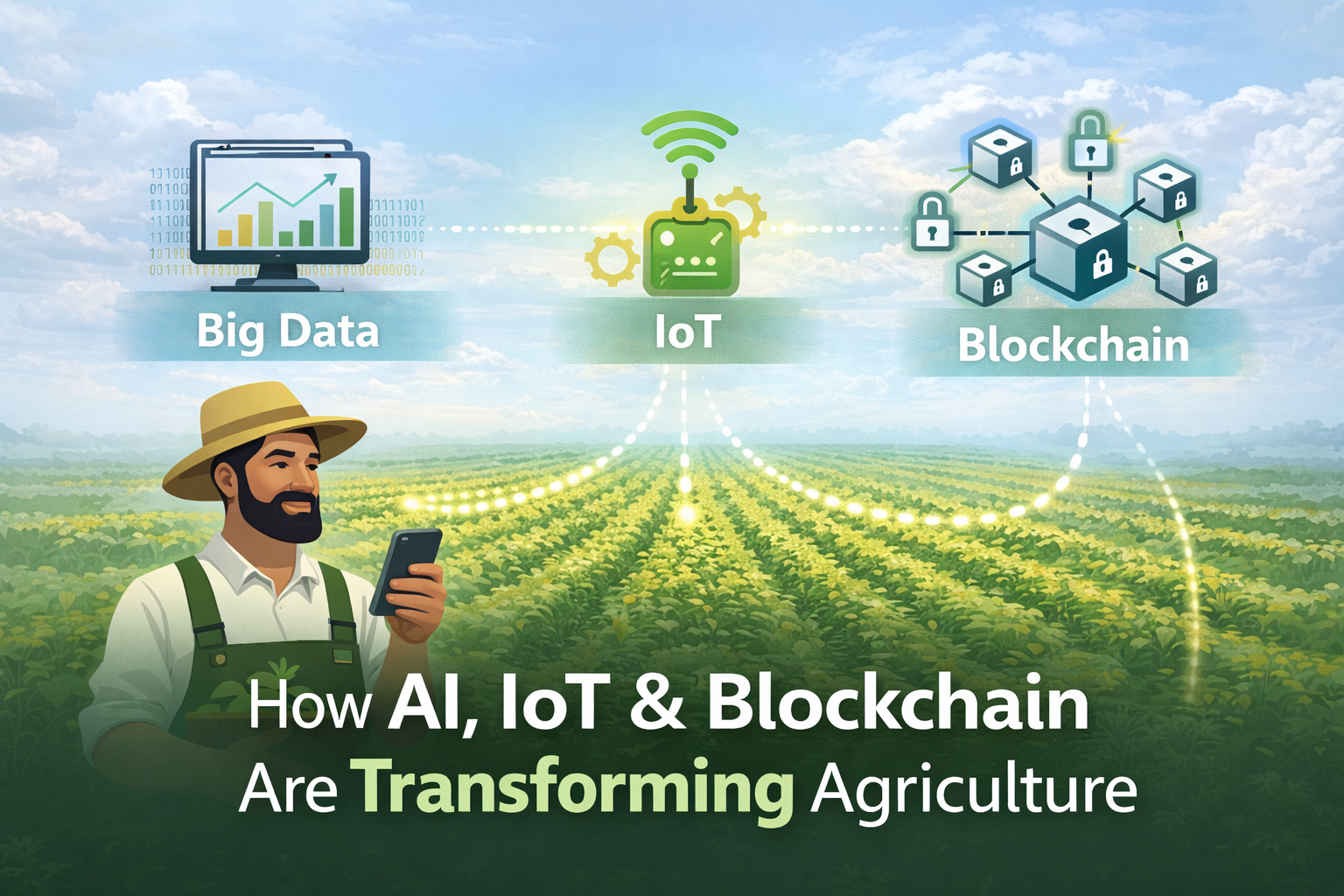
Agriculture is entering one of the most transformative phases in its history. For decades, farming has relied on experience, seasonal intuition, and fragmented information systems. However, climate volatility, market uncertainty, rising input costs, and supply chain inefficiencies have exposed the structural limitations of traditional agricultural models.
Globally, agriculture contributes trillions of dollars to the economy, yet profitability at the farmer level remains unstable. In India alone, over 140 million farmers operate in an ecosystem that is rich in effort but poor in integrated intelligence. The future of agriculture will not be defined solely by productivity, but by precision, predictability, and platformization.
Artificial Intelligence, Big Data, and Blockchain are not emerging technologies in isolation. Together, they represent a structural redesign of how agricultural economies function. Farmitra AI is positioned at the center of this transformation, building an integrated digital backbone for the next-generation agri-economy.
The Shift from Traditional Farming to Intelligent Agriculture
Historically, agriculture has been reactive. Farmers respond to pest attacks after damage appears. They sell crops based on immediate mandi prices. They apply fertilizers based on generalized advice rather than crop-stage precision. The result is inefficiency at scale.
The modern agritech movement is redefining this approach. Intelligence is shifting upstream. Data is becoming an asset. Decision-making is moving from guesswork to predictive modeling.
Artificial Intelligence now enables crop disease detection before large-scale spread. Machine learning models analyze soil, weather, and crop-stage data to generate hyper-local advisory. Big Data platforms aggregate regional pricing trends to forecast optimal selling windows. Blockchain ensures traceability, reducing disputes and improving credit confidence.
This is not digital decoration. This is structural modernization.
Artificial Intelligence: Turning Agricultural Uncertainty into Predictability
AI in agriculture is no longer experimental. It is becoming foundational. Image recognition models can detect leaf diseases with accuracy comparable to agronomists. Predictive analytics can estimate yield outcomes months before harvest. Climate models integrated with crop data can simulate stress scenarios.
The commercial impact of AI-driven advisory is measurable. Studies across global agritech deployments suggest that predictive advisory can reduce input waste by up to 25 percent while increasing yield consistency. More importantly, AI reduces risk — and in agriculture, risk mitigation directly translates into income stability.
Farmitra AI integrates crop-stage monitoring, disease detection workflows, and smart advisory engines into a unified farmer interface. Instead of offering isolated recommendations, it builds contextual intelligence. A farmer using Farmitra does not merely receive tips; he operates within a continuously learning advisory ecosystem.
This transforms the farmer from a reactive cultivator into a data-informed agri-entrepreneur.
Big Data: Unlocking Market Intelligence for Rural Economies
If AI provides intelligence at the field level, Big Data provides intelligence at the market level.
Agriculture generates massive datasets — soil reports, rainfall history, mandi prices, storage cycles, commodity demand fluctuations, and regional consumption patterns. Historically, this data has remained fragmented across agencies and institutions.
Big Data platforms now consolidate these layers to generate predictive market insights. Farmers no longer need to rely solely on local mandi pricing. Advanced analytics can forecast price trends, identify demand clusters, and suggest alternate selling strategies.
Farmitra’s Mandi Intelligence Engine integrates price tracking with predictive analytics to help farmers shift from distress selling to strategic selling. When a farmer understands not just today’s price but probable price direction, decision-making becomes economically optimized.
Market intelligence is no longer reserved for traders and aggregators. It becomes democratized.
Blockchain: Building Trust in the Agricultural Supply Chain
Trust remains one of the most undervalued assets in agriculture. Quality disputes, delayed payments, unclear grading mechanisms, and opaque transaction records reduce efficiency and increase friction.
Blockchain technology introduces a transparent, tamper-proof ledger system. Crop origin, storage quality, grading certification, and transaction logs can be recorded immutably. This reduces disputes and enhances buyer confidence.
In commercial terms, blockchain-backed systems reduce payment delays, lower credit risk, and enable commodity-backed lending models. Financial institutions can assess risk using verified transaction histories rather than informal assessments.
Farmitra’s architecture is being designed to integrate blockchain-enabled warehousing records, digital quality certification tracking, and secure farmer transaction logs. This ensures that trust becomes programmable rather than negotiable.
Platformization of Agriculture: The Ecosystem Advantage
The next phase of agriculture will not be driven by standalone apps. It will be driven by ecosystems.
Advisory without market linkage remains incomplete. Market access without financial inclusion remains limiting. Credit without predictive intelligence remains risky.
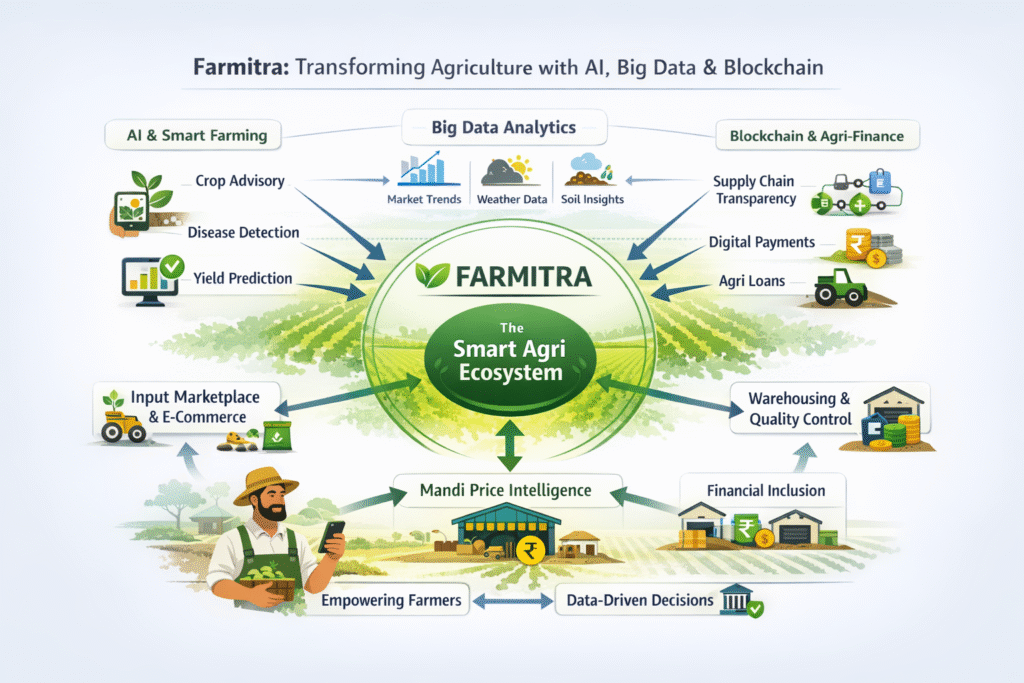
Farmitra positions itself not as a feature-based product but as an integrated agritech ecosystem combining:
- AI advisory systems
- Market intelligence
- Vendor and input marketplace integration
- Financial record management
- Storage and warehousing enablement
- Expert connectivity
This ecosystem approach increases farmer lifetime value, improves data accuracy across modules, and strengthens cross-functional monetization pathways.
In platform economics, integration compounds value.
Economic Implications: Strengthening the Agri-Economy
India’s agricultural economy is valued at hundreds of billions of dollars annually. Yet productivity inefficiencies, post-harvest losses, and price volatility reduce net economic output.
Technology-driven agricultural systems improve not only productivity but also liquidity and transparency. Better yield forecasting improves credit underwriting. Improved traceability enhances export compliance. Predictive analytics stabilizes supply chains.
Farmitra’s role extends beyond farm-level advisory. It contributes to macro-level agri-economic stability by enabling structured, data-backed decision-making at scale.
This is not merely digitization. It is economic optimization.
Read Articles: Artificial Intelligence in Agriculture: India’s Strategic Leap Toward Data-Driven Farming
The Road Ahead: Climate Resilience and Intelligent Infrastructure
Climate change is accelerating unpredictability in agriculture. Irregular rainfall patterns, extreme temperature variations, and soil degradation demand adaptive systems.
AI-driven climate modeling, sensor-based farm monitoring, carbon tracking systems, and digital warehousing networks will define the next frontier of agritech.
Farmitra’s modular technology architecture is designed to integrate IoT, predictive climate models, and financial intelligence layers without architectural redesign. This ensures scalability as technological adoption deepens.
The goal is not just productivity growth but resilience and sustainability.
Conclusion: Redefining the Future of Agriculture
Agriculture is transitioning from a labor-intensive sector to an intelligence-driven economy. Artificial Intelligence provides foresight. Big Data provides insight. Blockchain provides trust. Platform ecosystems provide scale.
Farmitra AI is building the convergence layer where these technologies interact seamlessly for farmer empowerment and economic acceleration.
The agritech revolution is not about replacing farmers. It is about amplifying their decision-making power with structured intelligence.
As agriculture evolves into a data-centric industry, platforms that integrate predictive advisory, market analytics, financial inclusion, and trust architecture will define the future.
Farmitra is not merely participating in this revolution.
It is engineering its foundation.
Download Farmitra APP
