
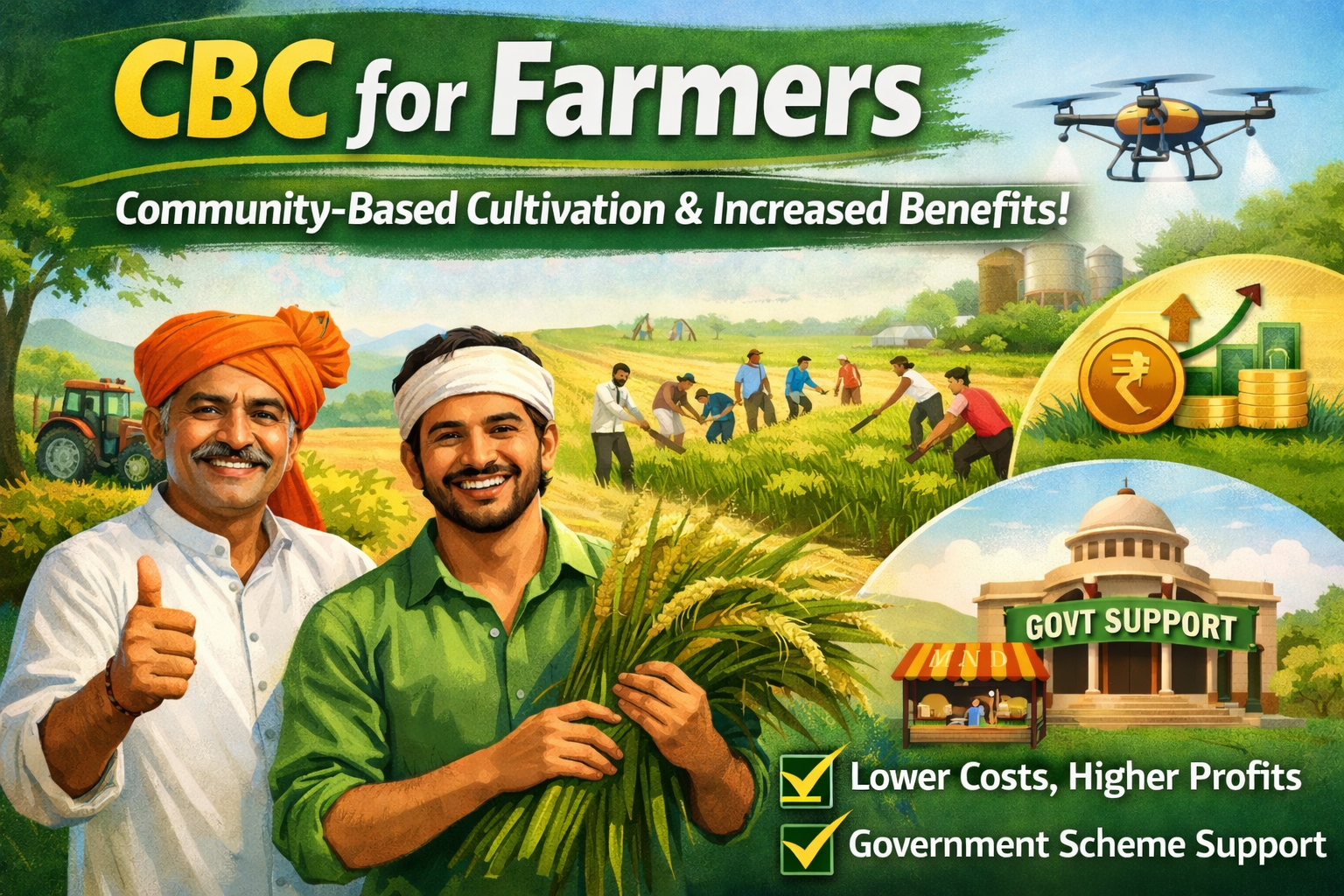
India’s agricultural sector is undergoing a gradual transformation through new policies, technologies, and institutional mechanisms aimed at improving farmer income and sustainability. One important concept that has recently gained attention in the agricultural ecosystem is CBC (Community-Based Cultivation). This approach encourages farmers to collaborate, share resources, and adopt modern agricultural practices collectively. For small and marginal farmers—who make up the majority of India’s farming community—CBC offers a pathway to reduce costs, improve productivity, and access better markets.

Community-Based Cultivation is essentially a model in which farmers in a village or cluster coordinate their farming activities, share inputs and resources, and collectively adopt improved agricultural technologies. Instead of operating individually with limited resources, farmers work as a community. This enables them to benefit from economies of scale, access advanced equipment, negotiate better prices for inputs, and sell their produce in larger quantities to bigger markets. The CBC model is increasingly being promoted through farmer organizations such as Farmer Producer Organizations (FPOs) and cooperative farming initiatives.
Why CBC Is Important for Indian Farmers
A large percentage of Indian farmers own very small landholdings. Because of this fragmentation, many farmers struggle with high input costs, limited access to modern machinery, and weak bargaining power in markets. CBC addresses these challenges by encouraging farmers to work collectively.
Under a CBC system, farmers can pool land or coordinate crop planning. For example, if a group of farmers grows the same crop using standardized practices, they can purchase seeds, fertilizers, and pesticides in bulk at lower prices. Additionally, they can share expensive agricultural equipment such as tractors, harvesters, and irrigation systems.
Another major advantage is better market access. When farmers collectively produce and sell crops, they can supply larger quantities to buyers such as food processing companies, exporters, or large retailers. This improves price realization and reduces dependence on middlemen.
Benefits of CBC for Farmers
Community-Based Cultivation provides several practical benefits that can directly improve farmers’ livelihoods:
1. Reduced Cost of Farming
Farmers can purchase agricultural inputs such as seeds, fertilizers, and pesticides in bulk. Bulk purchasing reduces per-unit costs and lowers overall production expenses.
2. Access to Modern Technology
Many small farmers cannot afford advanced machinery. Through CBC, machinery such as laser land levelers, seed drills, or combine harvesters can be shared among farmers.
3. Improved Crop Productivity
When farmers follow standardized crop practices and receive technical guidance collectively, crop productivity improves significantly.
4. Stronger Market Power
Collective production allows farmers to negotiate better prices with buyers and participate in larger supply chains.
5. Risk Sharing
Farming involves risks such as weather fluctuations and pest attacks. When farmers collaborate, they can share risks and implement better crop management strategies.
Government Initiatives Supporting CBC
The Government of India is actively encouraging collaborative agricultural models through several programs. Some of the key initiatives include:
Promotion of Farmer Producer Organizations (FPOs)
The government has launched a major program to create 10,000 Farmer Producer Organizations across India. These FPOs enable farmers to work collectively, procure inputs together, and sell produce at better prices.
Agricultural Mechanization Schemes
Government schemes under the Sub-Mission on Agricultural Mechanization (SMAM) support community-level farm machinery banks where farmers can rent equipment at subsidized rates.
Digital Agriculture and Data Platforms
The government is increasingly promoting digital agriculture platforms that provide farmers with information on weather, markets, crop management, and government schemes.
Cluster-Based Agricultural Development
Programs like Paramparagat Krishi Vikas Yojana (PKVY) and cluster-based organic farming promote farming communities working together within a defined geographic cluster.
How Farmitra Helps Farmers in the CBC Model
Modern digital platforms are playing a key role in enabling farmers to adopt community-based agriculture. Farmitra, as an AI-powered agritech platform, supports farmers by providing tools and insights that help them collaborate, plan crops better, and access real-time market information.
Farmitra helps farmers in several ways:
Crop Planning and Advisory
Farmers can receive intelligent crop recommendations based on soil conditions, weather patterns, and regional practices.
Mandi Price Insights
Through the Farmitra Mandi Analyzer, farmers can track live mandi prices, helping them decide when and where to sell their produce for maximum profit.
AI-Based Crop Health Monitoring
Farmers can use Farmitra’s AI tools to detect crop diseases and receive timely recommendations for treatment.
Community Knowledge Sharing
Farmitra enables farmers to connect with experts and other farmers, creating a digital farming community that supports collaborative agriculture.
Market Linkage and Digital Support
Farmers can explore new market opportunities and receive guidance on government schemes, subsidies, and agricultural best practices.
The Future of Community-Based Agriculture in India
As agriculture continues to evolve, collaborative farming models like CBC will play a crucial role in improving farmer incomes and strengthening the agricultural economy. With support from government policies, farmer organizations, and digital agritech platforms, community-based agriculture can help small farmers overcome structural challenges and compete in modern agricultural markets.
Digital solutions like Farmitra are expected to further accelerate this transformation by combining data, artificial intelligence, and farmer networks. By empowering farmers with information and enabling collective action, CBC models can create a more resilient and profitable agricultural system in India.