
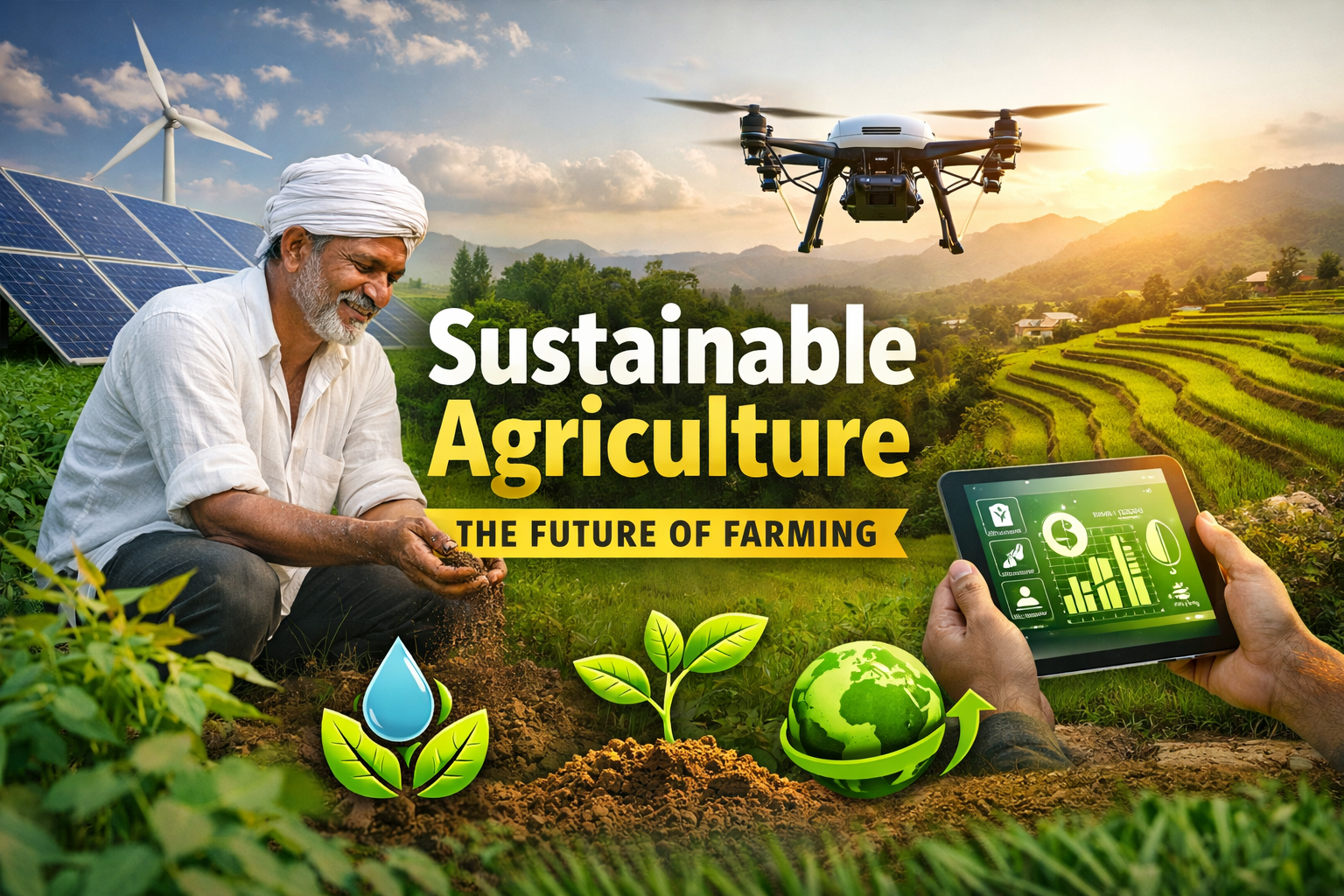
Sustainable agriculture has emerged as one of the most critical global priorities in the 21st century. As the world population approaches 10 billion by 2050, the pressure on agricultural systems is intensifying. Farmers must produce more food than ever before, yet they must do so while protecting soil health, conserving water resources, reducing greenhouse gas emissions, and preserving biodiversity.
Traditional agricultural practices, particularly those relying heavily on chemical fertilizers, excessive irrigation, and monoculture farming, have contributed to soil degradation, water scarcity, and declining farm productivity in many regions. These challenges are especially significant in developing agricultural economies such as India, where millions of smallholder farmers depend on agriculture for their livelihoods.
Sustainable agriculture provides a comprehensive solution to these challenges. It integrates ecological balance, economic profitability, and social responsibility, ensuring that farming systems remain productive and resilient for generations to come.
With the advancement of agricultural technology, platforms like Farmitra AI are playing a crucial role in enabling farmers to adopt sustainable farming practices through data-driven insights, intelligent crop recommendations, and real-time agricultural advisory services.
What is Sustainable Agriculture?
Sustainable agriculture refers to farming systems that maintain productivity while protecting natural resources and ecosystems. The objective is to produce sufficient food while minimizing environmental impact and maintaining the long-term viability of agricultural land.
According to global agricultural frameworks, sustainable agriculture is based on three fundamental pillars:
Environmental Sustainability
Farming practices must protect soil, water, biodiversity, and ecosystems. Sustainable farming reduces chemical usage, encourages organic inputs, and improves soil health.
Economic Sustainability
Farmers must be able to generate stable and profitable income while maintaining production efficiency and minimizing input costs.
Social Sustainability
Agricultural systems must support rural livelihoods, ensure food security, and promote fair working conditions within farming communities.
Countries across the world are now integrating sustainable agriculture policies into their national food security strategies.
Why Sustainable Agriculture is Important Globally
The need for sustainable agriculture is driven by several global challenges affecting the food system.
Climate Change and Agriculture
Agriculture is highly sensitive to climate variability. Rising temperatures, unpredictable rainfall patterns, droughts, and extreme weather events are increasingly affecting crop yields worldwide.
At the same time, agriculture itself contributes nearly 24% of global greenhouse gas emissions, largely due to fertilizer usage, livestock production, and land-use change.
Sustainable agricultural practices help reduce these emissions while improving climate resilience.
Soil Degradation
Approximately one-third of the world’s soil is degraded, according to the Food and Agriculture Organization (FAO). Intensive farming practices, excessive tillage, and chemical inputs have significantly reduced soil fertility.
Sustainable farming focuses on restoring soil health through:
- Crop rotation
- Organic matter management
- Reduced tillage
- Biological soil enrichment
Healthy soil improves crop productivity while also storing carbon and retaining water.
Water Scarcity
Agriculture accounts for nearly 70% of global freshwater usage. Inefficient irrigation practices have caused severe water stress in many agricultural regions.
Sustainable agriculture promotes water-efficient practices such as:
- Drip irrigation
- Precision irrigation systems
- Rainwater harvesting
- Soil moisture monitoring
These techniques allow farmers to conserve water while maintaining optimal crop growth.
Sustainable Agriculture in India
India is one of the largest agricultural economies in the world, with over 140 million farmers cultivating crops across diverse climatic zones. However, Indian agriculture faces several sustainability challenges.
These include:
- Declining soil fertility due to excessive fertilizer use
- Groundwater depletion
- Climate variability affecting crop cycles
- Rising input costs
- Fragmented land holdings
To address these challenges, sustainable agricultural approaches such as natural farming, organic farming, integrated farming systems, and precision agriculture are gaining popularity.
Government initiatives like:
- National Mission for Sustainable Agriculture (NMSA)
- Paramparagat Krishi Vikas Yojana (PKVY)
- Soil Health Card Scheme
are actively promoting sustainable agricultural practices across India.
Key Practices of Sustainable Agriculture
Several farming techniques help improve sustainability in agricultural systems.
Crop Rotation
Crop rotation involves growing different crops sequentially on the same field. This helps maintain soil fertility and reduces pest infestation.
For example, rotating legumes with cereals naturally enriches soil nitrogen levels.
Integrated Pest Management (IPM)
IPM focuses on reducing chemical pesticide use by combining biological control, natural predators, and targeted pest monitoring.
This reduces environmental pollution and improves ecosystem balance.
Organic Fertilization
Instead of relying solely on chemical fertilizers, sustainable agriculture promotes organic inputs such as:
- Compost
- Vermicompost
- Green manure
- Biofertilizers
These inputs improve soil structure and microbial activity.
Precision Agriculture
Modern technologies now enable farmers to apply inputs with extreme accuracy using sensors, drones, and satellite imagery.
Precision agriculture allows farmers to:
- Apply fertilizers only where needed
- Monitor crop health using AI
- Optimize irrigation schedules
- Reduce input wastage
This significantly improves sustainability.
Role of AI and Technology in Sustainable Agriculture
Technology is transforming the way sustainable agriculture is implemented worldwide.
Artificial intelligence, satellite monitoring, IoT sensors, and data analytics are helping farmers make informed decisions.
Digital agriculture platforms now provide:
- Crop disease detection
- Soil nutrient recommendations
- Weather prediction
- Market price intelligence
- Farm management tools
These innovations enable farmers to maximize productivity while minimizing environmental impact.
How Farmitra AI Supports Sustainable Agriculture
Farmitra AI is designed to support farmers by combining artificial intelligence with practical agricultural advisory systems.
The platform helps farmers adopt sustainable farming techniques through intelligent digital tools.
AI-Powered Crop Advisory
Farmitra AI provides crop-specific guidance based on local soil conditions, weather patterns, and regional farming practices.
Plant Disease Detection
Using image-based AI diagnosis, farmers can detect crop diseases early and apply targeted treatment rather than excessive pesticide use.
Mandi Price Intelligence
Farmitra helps farmers access real-time mandi prices, enabling better crop planning and reducing post-harvest losses.
Smart Farming Recommendations
Farmitra AI suggests optimized fertilizer use, irrigation scheduling, and crop stage management to improve sustainability.
Expert Consultation
Farmers can connect with agricultural experts to receive personalized advice for improving crop productivity while maintaining environmental balance.
Through these features, Farmitra AI empowers farmers to transition toward technology-driven sustainable agriculture.
Benefits of Sustainable Agriculture for Farmers
Adopting sustainable agriculture offers multiple long-term advantages.
Improved Soil Fertility
Healthy soil leads to higher yields and better crop quality.
Reduced Input Costs
Optimized fertilizer and pesticide use lowers farming expenses.
Climate Resilience
Sustainable practices help crops withstand drought, floods, and climate variability.
Long-Term Farm Productivity
Maintaining ecological balance ensures farmland remains productive for future generations.
Access to Premium Markets
Organic and sustainably produced crops often receive higher market prices.
The Future of Sustainable Agriculture
The future of agriculture lies at the intersection of ecology, technology, and innovation. Sustainable agriculture is no longer just an environmental movement; it is a global economic necessity.
As climate challenges intensify and food demand rises, the world must shift toward data-driven, climate-smart farming systems.
Artificial intelligence, precision agriculture, and digital advisory platforms will become essential tools for farmers worldwide.
Platforms like Farmitra AI represent the next generation of agricultural technology — empowering farmers with knowledge, tools, and market intelligence needed to practice sustainable farming effectively.
Conclusion
Sustainable agriculture is the foundation of long-term global food security. By balancing productivity with environmental responsibility, farmers can ensure that agricultural systems remain resilient and profitable for decades to come.
For countries like India, where agriculture supports millions of livelihoods, the adoption of sustainable farming practices is not only necessary but inevitable.
Through the integration of advanced technologies and intelligent platforms such as Farmitra AI, farmers can transition toward efficient, climate-resilient, and sustainable agricultural systems.
The future of farming will depend on how effectively the global agricultural community embraces sustainability today.