
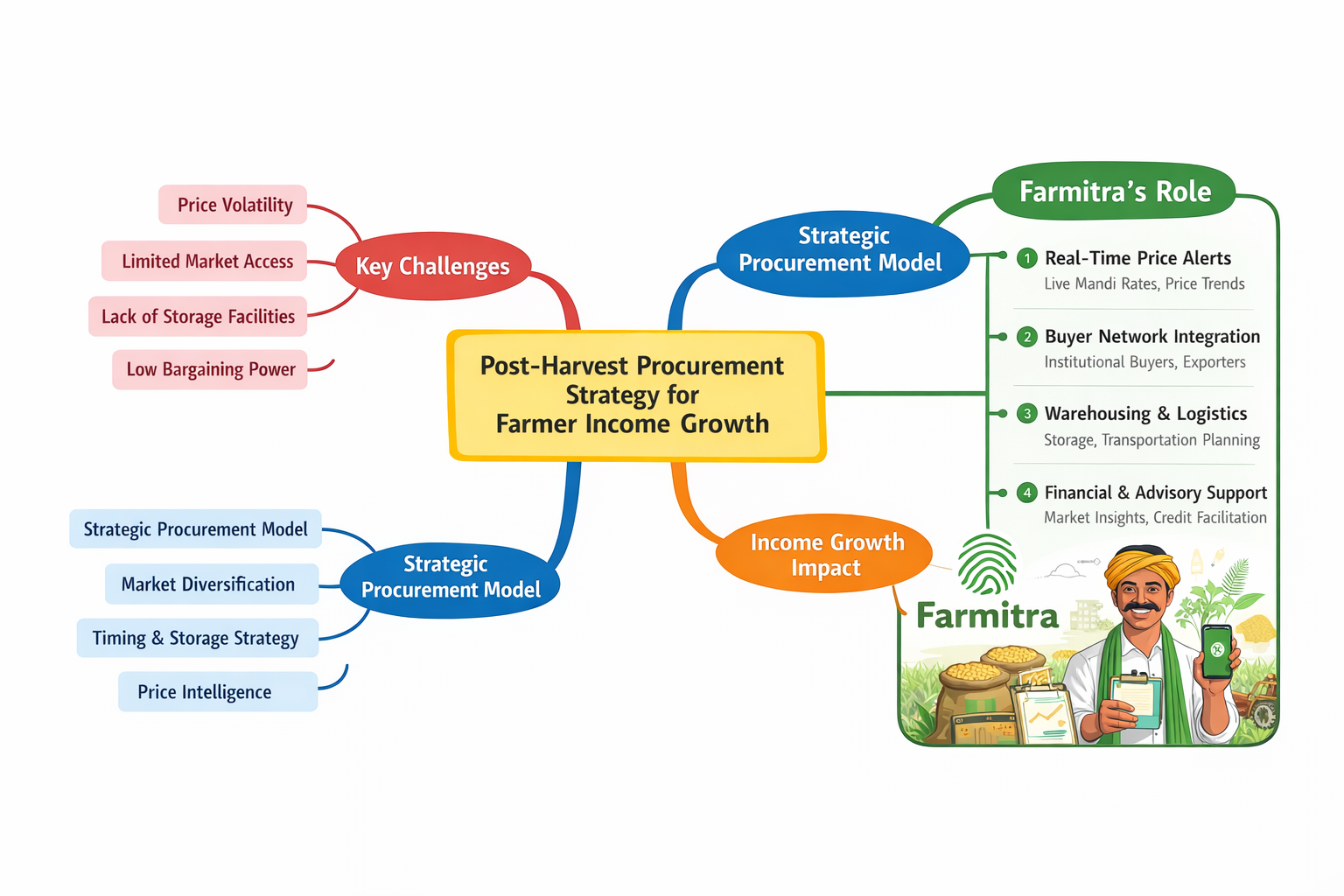
In India and other emerging agrarian economies, productivity gains at the farm level do not consistently translate into proportional income growth. The primary structural gap lies in post-harvest procurement inefficiencies—price volatility, fragmented buyer networks, limited storage access, and asymmetry of market information. This article presents a commercial, research-oriented framework for strengthening farmer income through structured post-production procurement strategy. It also outlines how Farmitra, as a digital agri-commerce ecosystem, can operationalize this transformation.
1. Introduction: The Post-Harvest Income Paradox
Agricultural policy and extension systems have historically prioritized yield enhancement. However, multiple studies in agri-economics demonstrate that income variability is more strongly influenced by market access and price realization than by incremental yield gains alone.
After production, farmers face three critical decision variables:
- Timing of sale
- Choice of market channel
- Negotiation leverage
Without structured procurement planning, farmers often sell immediately after harvest—precisely when supply peaks and prices decline.
A commercial reorientation from “production-centric farming” to “market-aligned farming” is therefore essential.
2. Procurement After Production: A Structured Model
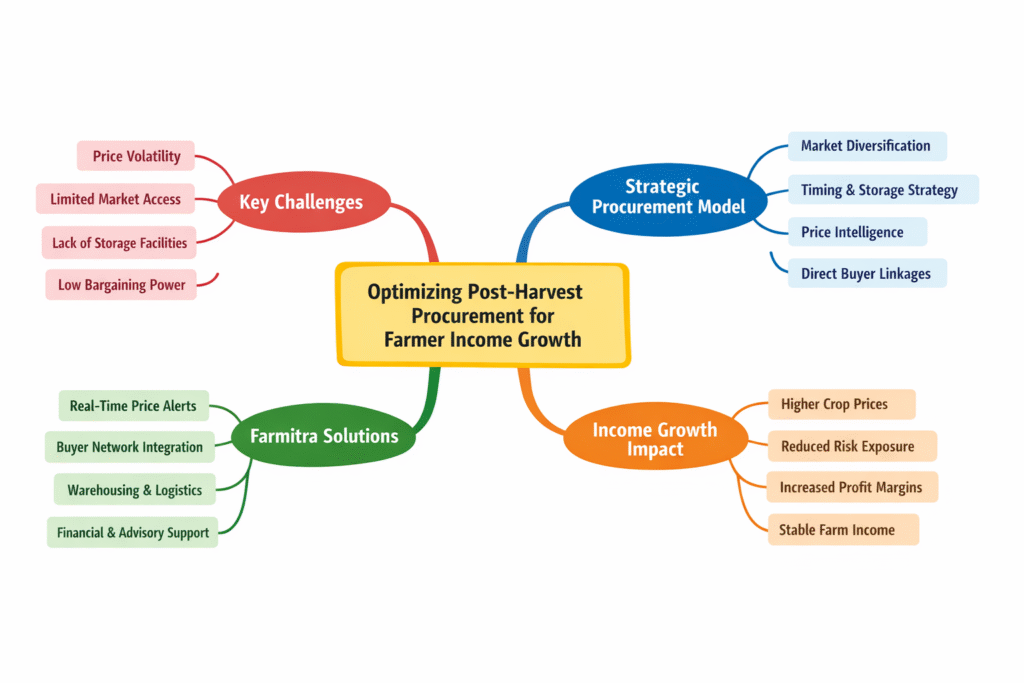
2.1 Channel Diversification Model
A resilient procurement framework includes multiple sales channels:
- Local mandis (regulated markets)
- Direct institutional buyers (millers, processors)
- Contract farming partners
- Aggregator-led digital marketplaces
- FPO-led collective marketing
Commercial Insight:
Farmers who diversify sales channels reduce price dependency risk by up to 25–35% compared to single-channel sellers.
2.2 Timing Optimization and Storage Economics
Immediate liquidation of produce often results in suboptimal price realization. Strategic storage—where feasible—creates arbitrage opportunities.
Key Variables:
- Storage cost per quintal
- Quality deterioration rate
- Expected seasonal price increase
- Liquidity requirements of farmer
A structured decision matrix should include:
- Net storage return ratio
- Break-even price curve
- Risk-adjusted holding period
2.3 Price Intelligence and Data Asymmetry
Price discovery inefficiencies are among the largest structural constraints in rural markets. Farmers frequently lack:
- Cross-mandi price comparisons
- Institutional buyer bids
- Demand forecasts
A real-time data framework reduces information asymmetry and strengthens negotiation power.
3. Commercial Constraints in Indian Procurement Ecosystems Fragmentation
Small landholdings limit volume bargaining power.
3.2 Logistics Inefficiency
High transportation cost per unit reduces net realization.
3.3 Lack of Quality Standardization
Absence of grading systems weakens premium pricing potential.
3.4 Financial Pressure
Immediate cash needs force distress selling.
4. Integrated Commercial Procurement Framework
A modern procurement strategy must combine:
- Market intelligence
- Aggregation
- Digital transparency
- Logistics integration
- Financial liquidity support
The following layered approach is recommended:
Layer 1: Market Forecasting
Pre-harvest demand analysis and buyer mapping.
Layer 2: Quality Grading
Standardized sorting and classification to command premium pricing.
Layer 3: Aggregation Model
Cluster-level pooling via FPO or digital coordination to increase volume leverage.
Layer 4: Strategic Storage
Warehouse receipt systems for deferred sale.
Layer 5: Institutional Buyer Integration
Direct linkage with processors, exporters, and bulk buyers.
5. Role of Farmitra in Post-Harvest Commercial Optimization
Farmitra operates as a digital agricultural ecosystem designed to bridge production and commercialization.
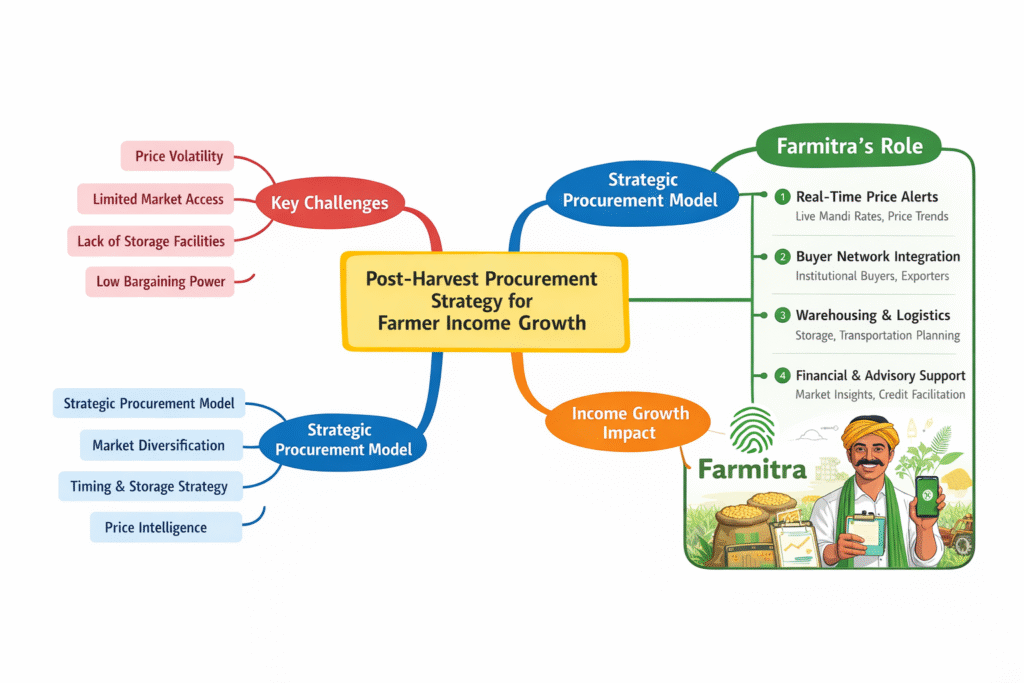
5.1 Real-Time Mandi Rate Intelligence
Cross-location price comparison enables timing optimization.
5.2 Buyer Network Integration
Direct connectivity with processors, traders, and institutional procurement entities.
5.3 Digital Record Management
Through modules such as Krishi Bahi and KhataBook, farmers gain financial visibility, allowing informed sales decisions.
5.4 Advisory Layer
Expert-backed recommendations on:
- When to sell
- Where to sell
- How to grade and store
5.5 Logistics and Aggregation Coordination
Cluster-based shipment planning reduces per-unit transportation cost.
6. Economic Impact Projection Model
A structured procurement strategy can influence farmer income across three dimensions:
| Parameter | Traditional Sale Model | Structured Procurement Model |
|---|---|---|
| Price realization | Market-day dependent | Optimized through timing |
| Risk exposure | High | Diversified |
| Net margin | Low–moderate | Moderate–high |
| Bargaining power | Limited | Improved via aggregation |
| Financial predictability | Unstable | Stabilized |
Projected income improvement potential (varies by crop and region):
12–30% incremental realization over baseline distress sale conditions.
7. Strategic Recommendations for Policymakers and Agri Enterprises
- Promote cluster-based aggregation.
- Expand warehouse receipt financing.
- Strengthen digital price transparency.
- Encourage procurement digitization.
- Incentivize grading and quality standardization.
8. Conclusion
Farmer growth in the coming decade will not be driven solely by higher yields, but by structured commercialization and procurement intelligence. Post-harvest strategy must evolve from reactive selling to data-driven decision-making.
Farmitra positions itself not merely as a digital advisory platform, but as a commercial infrastructure enabler—integrating price intelligence, aggregation, logistics, and financial visibility into a unified procurement framework.
In an era of volatile markets and rising input costs, strategic post-production procurement is no longer optional. It is the cornerstone of sustainable farmer income growth.
Read : AI in Soil Health and Fertilizer Management: A Game-Changer for Indian Farmers
Download Farmitra APP
